
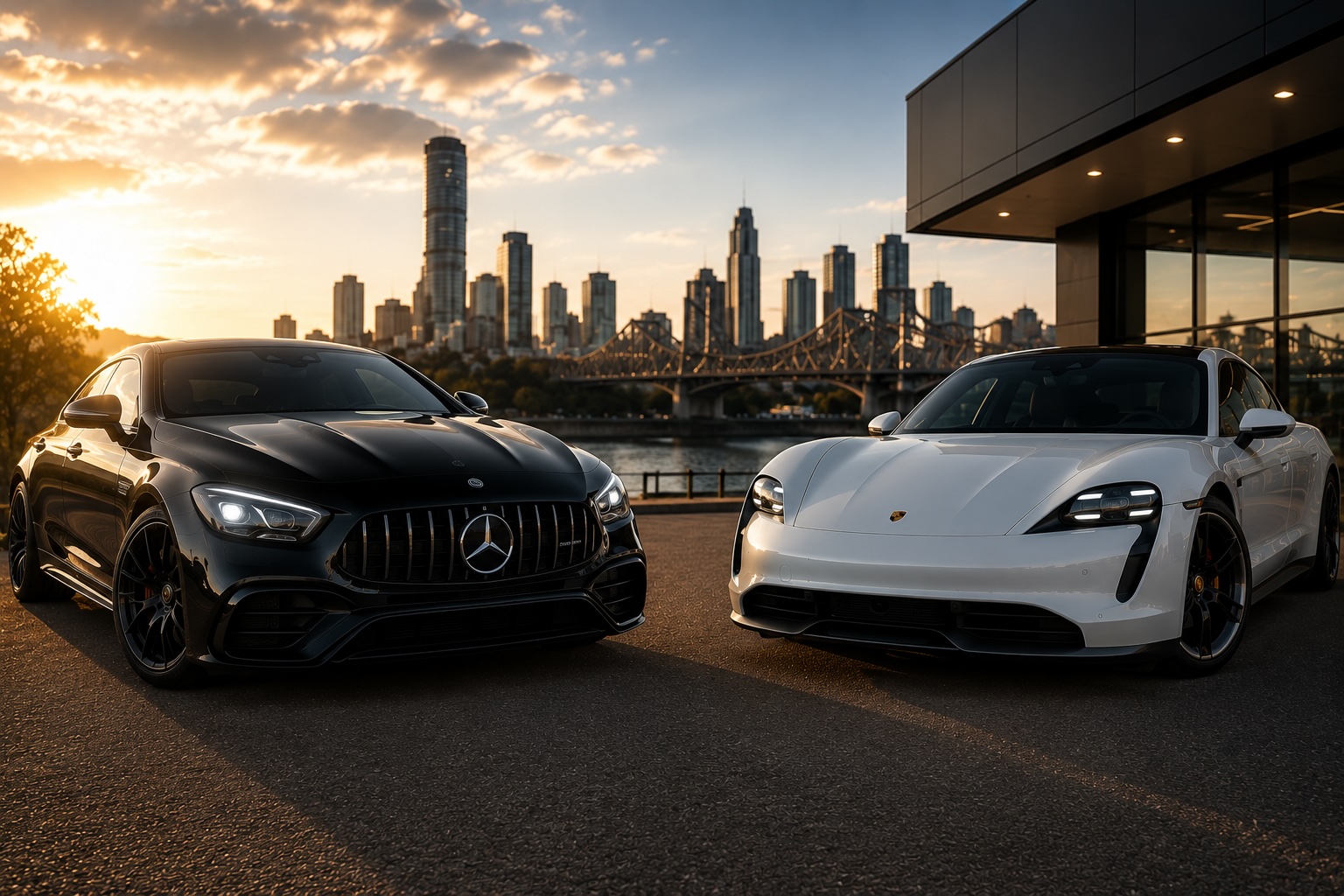
The prestige segment has absorbed the arrival of full electrification in a way few would have predicted a decade ago. Porsche, Mercedes-Benz, Audi, BMW, Lexus, Polestar, and the Tesla S and X have all reshaped what a luxury vehicle is meant to be. For a buyer working through the segment in 2026, the decision is no longer simply which marque or which model. It is whether the next car runs on combustion or current.
This is a side-by-side framing of how a petrol prestige car and an electric luxury car compare across the questions buyers approaching the luxury cars for sale market actually ask.
Driving character and the experience of the road
A petrol prestige car carries a sound, a cadence, and a sense of mechanical theatre that has been refined across decades. A naturally aspirated V8 from AMG, a flat-six from Porsche, or a turbocharged inline-six from BMW M each has a distinct vocal signature that forms part of why these cars are bought in the first place. For a buyer who values the moment of starting the engine, the swell of an exhaust note through a tunnel, and the connection between throttle and combustion, the case is straightforward.
An electric luxury car offers a different experience. Instant torque from rest changes how the car feels in the first metre of acceleration. The cabin is quieter at urban speeds than almost any internal-combustion equivalent. Regenerative braking, one-pedal driving, and the cleanness of power delivery form a new kind of driving character many buyers come to prefer once they have lived with it.
Neither character is superior in absolute terms. They are different propositions for different priorities.
Ownership cost across the year
The running cost picture is where the comparison becomes practical.
A petrol prestige car carries fuel costs that move with global pricing and Australian excise. Servicing tends to be more expensive than a mainstream petrol car due to specialist labour and parts, but the service network is established, parts are widely available, and the broader specialist community is mature.
An electric luxury car typically carries lower energy costs per kilometre, particularly for owners with home solar or off-peak charging. Servicing is generally less frequent and involves fewer mechanical items. Brake wear tends to be lower due to regenerative braking. Against that, tyre wear can be higher on the heavier EV platforms, and battery service items, when they arise, are at the high end of the segment cost spectrum.
For most ownership profiles, an electric luxury vehicle wins on day-to-day running cost. Whether that difference is decisive depends on the buyer's annual kilometres and how the rest of the ownership question lines up. For buyers weighing luxury cars for sale on a total-cost-of-ownership view rather than a sticker view, running cost can shift the answer meaningfully.
Depreciation and residual position
Depreciation is where this comparison gets more nuanced.
Established petrol prestige cars from recognised marques tend to follow a predictable curve. Porsche 911 variants, certain Mercedes-AMG and BMW M generations, and the rarer Audi RS specifications have well-documented residual patterns that buyers of used luxury cars in Australia have learned to read.
Early-generation electric models, by contrast, have depreciated faster than their petrol counterparts in many cases. The combination of rapid technological progress, falling battery costs, and a new model cycle that has accelerated in recent years has put downward pressure on used EV pricing. For a buyer entering an electric variant at the used end, this depreciation is the opportunity. For a buyer holding a current-generation EV, it is the cost of being early.
The newer wave of premium EVs from Porsche, Mercedes-EQ, Audi e-tron, Lexus, BMW iX, Polestar, and the Tesla S and X are stabilising more predictably as the segment matures.
Infrastructure and the practical week
Charging infrastructure in Australia in 2026 is substantially more comprehensive than it was even three years ago, with high-power DC charging now established along major highway corridors and across most metropolitan centres. For urban and suburban owners with home charging, range anxiety is largely a question that belongs to an earlier phase of the segment.
For long-distance touring, an electric luxury car still requires a degree of route planning that a petrol equivalent does not. The 600-kilometre dash up the coast on a public holiday is a different proposition in an EV in mid-2026 than in a petrol GT. Closer to home, the practical week often favours the EV, with home charging quietly handling the daily commute and the car being topped up when not in use.
A petrol prestige car remains the simpler proposition for buyers without home charging, for high-touring use cases, and for those who specifically value the refuelling cadence of internal combustion ownership. Both groups remain well served among the luxury cars for sale at any given moment.
Segment direction and the case for both
The prestige segment in 2026 is genuinely dual-track. Manufacturers continue to invest in combustion development at the performance end, with hybrid assistance now common across petrol prestige cars. The EV side continues to expand with more variants and more refined platforms.
For buyers weighing the luxury cars for sale in Australia today, both options are viable. Both have segment depth, both have specialist support, and both will hold a place in the prestige conversation.
The right car for the right owner
There is no segment-wide verdict that holds. A petrol GT for a touring owner, an electric prestige sedan for an urban commuter, a hybrid prestige SUV for a family that wants both, or a recognised collector-grade combustion variant for the buyer who already knows which generation they are after. Each is the right answer for a different question.
If you are weighing the comparison against your own ownership profile, the most useful next step is a conversation with a team that knows both sides of the segment. MCT Motorsport holds inventory across petrol, hybrid, and electric among the luxury cars for sale from the recognised premium marques, and the conversation begins with the car that fits the way you actually drive.